







Before the sprawling maps of Westeros. Before the global phenomenon of prestige television was incarnated on HBO’s Game of Thrones. Before George R.R. Martin was a household name, he was a kid in the projects of Bayonne, New Jersey, clutching a “sticky quarter”.
In a recent presentation, Martin stepped away from the Iron Throne to honor a different kind of lineage: the life and “weird-ass” imagination of his late friend, Howard Waldrop. It was a meditation on a lost era of creativity, one defined not by streaming algorithms, but by three-cent stamps and the purple haze of Ditto machines.
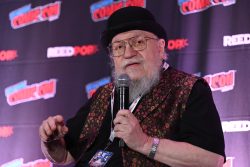
George RR Martin during New York Comic Con 2025 – Photo Jesse Rylander.
The Amateur’s Dignity
The bond between Martin and Waldrop began in 1963, a year before the first New York Comic-Con, when John F. Kennedy was in the White House. It started with a transaction for Justice League #28. Because a junior high student in the sixties did not have a checking account, Martin taped a quarter to an index card, a “sticky quarter,” and mailed it to Arlington, Texas.
The comic arrived protected by a cardboard stiffener. On that cardboard, Waldrop, a storyteller and artist even then, had drawn a barbarian and scribbled a simple question: “Do you like Conan?”.”I like Conan,” Martin recalled. From that exchange, a correspondence was born that would span decades and define two professional lives.
At the time, both were active in comic book fandom, reaching for the stars with fanzines. These were amateur magazines that paid nothing but offered total creative freedom. Martin was writing about “The White Raider,” a superhero on skis, despite the fact that Martin had never been on a set of skis in his life. Waldrop was already zigging where the world zagged, writing historical fiction about Roman legions while others focused on capes and masks.
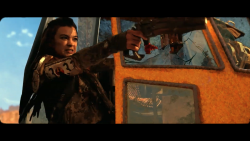
Mary Margaret Road Grader – Lumenscapes Illumination Media
The Ghost of the Future
It was during these early years that Waldrop developed characters like Dr. Weird. Predating Marvel’s Doctor Strange, Dr. Weird was a “Ghost of the Future,” a researcher who traveled back in time to the 1960s only to be killed by a burglar moments after arriving.
Because he died before he was born, he was cursed to roam the earth as a spirit until the day he would eventually be born and build his time machine. It was a quintessential Waldrop concept: science fiction rooted in a bittersweet, ghostly irony.
Night Of The Cooters – George RR Martin, Lumenscapes, Trioscope Studios
Translating the Impossible
To ensure the world finally gave a damn about these stories, Martin moved from correspondent to producer. He helped bring three of Waldrop’s stories to the screen as short films, each employing distinct techniques to capture Waldrop’s disparate worlds.
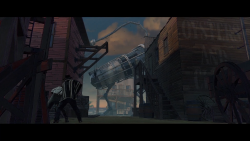
Night Of The Cooters – George RR Martin, Lumenscapes, Trioscope Studios

The first, The Ugly Chickens, stars Felicia Day and explores the mystery of the dodo bird. Martin recalled pitching an adaptation to CBS for The Twilight Zone in the eighties, only to be met with executive indifference: “Who the fuck gives a damn about dodo birds?”. This time, the production did “a better job” than the network ever could.

Mary Margaret Road-Grader took a different technical path. This “feminist tractor pull story” is set in a post-Holocaust landscape featuring an entirely American Indian cast. Written by Oklahoma Native American screenwriter Stephen Paul Judd, the film utilizes actors from the series Dark Winds to bring Waldrop’s indigenous futurism to life.

Then there is Night of the Cooters, a project that required a “top team” including Vincent D’Onofrio, who both directed and starred. Waldrop was the only reader to notice H.G. Wells’ War of the Worlds mentioned ten explosions on Mars, but only eight cylinders landed on Earth. The film explores what happened to those other two cylinders: they landed in Texas.
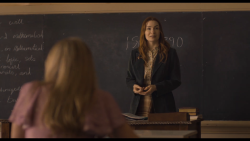
The Ugly Chickens – Fidelio Films
Preserving the Lineage
Martin described Waldrop as a man who “never had any money,” a writer who spent his fifties living in student housing just to keep the dream of the short story alive. He was a creator who famously turned down a Star Wars novelization because he was “going to do weird-ass stories” instead.
“You can’t make any money writing short stories,” Martin noted, yet that was where Waldrop’s genius lived. These films were more than just content; they were a way to get money to a friend in assisted living and to honor a voice that was “a lot different than like my fantasy or Tolkien’s fantasy”.
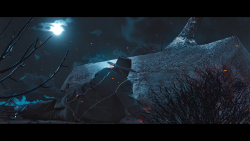
Night Of The Cooters George RR Martin, Lumenscapes, Trioscope Studios
Waldrop passed away in early 2024, but not before seeing the rough cuts of the films. He saw the last one just six days before he died. “He liked it,” Martin said, with a quiet gravity. “That was very important to me”.
In an industry that often favors the franchise and the familiar, Martin’s presentation served as a reminder that the most valuable thing a creator can have is the courage to be “weird”. Because a culture that forgets its eccentric lineage loses the very soul that makes the work worth doing and inspiring in the first place.