





There’s no denying it, Latvian animation studio Panic has been on a tear recently.
Since 2020, they’ve worked with a plethora of global brands, won a Motion Award, expanded across Europe and North America, and, just this month, acquired Amsterdam-based creative studio Kingdom of Something.
That’s one hell of a run.
You’d be forgiven for thinking they came out of nowhere. Half of their prospects have never even heard of Latvia, and the other half think it’s part of Eastern Europe.
So, how did this independent (coughs) Northern European animation studio transcend their geography and become a leading player in the industry?
Well, for that, we’ve got to understand where they came from.

At 27 years old, Gints was at a crossroads. He didn’t want to be another frustrated animator, working long hours at a digital agency, then going home to stew over how much he hated it.
But it was 2014. In Latvia!
It’s not like he could just march down the road with his laptop, kick open the door to one of 50 creative studios within a square mile, and blow their socks off, with his show reel. This wasn’t New York. And even if it was, he wasn’t that guy.
His memory is hazy from back then, but at some point, he must have reached the point where he could not bear to look at another “effing flash banner,” let alone design one in multiple languages, formats, and sizes. Every. Single. Day.
It was time to leave his dissatisfying, but well-paid job and start his own thing.
With no clients, no money, and no entrepreneurial experience (this is a guy who hates sending emails), there was only one thing he could do: Panic
That feeling, that name, would come to represent a mindset that would power the next few years: courage in the face of uncertainty, a willingness to push to the edge, and an unapologetic authenticity.
Still, they were a long way from the Panic of today, and to get there, they needed another piece.
Rita had worked with Gints at the digital agency.
“Even before Panic was official,” she says, “I felt like I might end up here. I always believed in Gints’ vision, and we already had a great dynamic.”
12 months later, she was brought on as a producer, but as anyone in a young business knows, it’s easy to get pulled into every department. Rita was out winning new clients early on, some of whom are still with them today, and would later join Gints as the spine of the creative team.
Within two years, they had four animators working full-time.
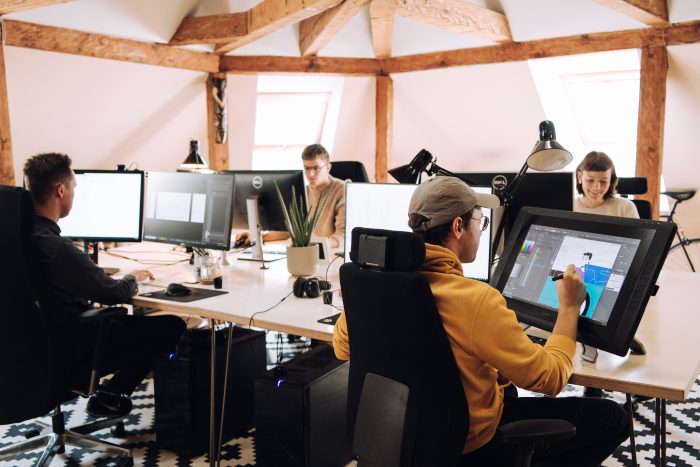
They spent a few months in a shared office space, but let’s just say Gints is someone who knows exactly what he wants.
“That Coworking space was… an experience,” Gints says. “I quickly realized I needed my own corner, somewhere you don’t have to label your lunchbox or explain to a stranger if there’s anything ‘interesting’ you’re working on.”
Rita laughs. “When you start something new, you need all aspects pushing you in the right direction. It’s not just the mindset of having an office, but also creating space for people and ideas to bounce off each other. We needed a home.”
Prisoners of Geography
For six years, Panic chugged along.
They grew steadily, did great work, but they struggled to break through in a saturated market. As Tim Marshall would say, they were prisoners of geography.
If you think I’m exaggerating, think about this: The environment of a business will often dictate how much it can grow.
And I’m sorry to say, some things just can’t grow that big.
If you own a cafe and you only have 40 seats, you’re limited in revenue until you knock down a wall or open somewhere new. If you’re in a place with limited opportunity, you need to get it from elsewhere.
The 2010s were the perfect decade for this. As social media and online workflows became more prevalent, digitally aware companies could supplement their core teams with creatives from all over the world and, of course, get in front of larger clients.
They’d taken a thousand tiny steps; what they needed now was a big leap. Something that proved they could hang with the industry’s top players.
Rita tells me, “The biggest frustration of working on smaller projects is that you can’t show what you’re capable of. We knew we had so much more to give, but we had no chance of proving it. We’d come up with all these ideas, and they’d say, ‘We just want a simple explainer video.’”
If you’re even mildly interested in personal growth, you’ll know that every once in a while, you get stung by a life-changing philosophical question.
Panic got theirs while Rita and Gints were meeting an agent from New York.
The agent took a sip of his coffee and said, “I’m sitting in Manhattan. I have 30 studios within a mile radius. Why should I choose you?”
Gulp…
“It was very crushing,” says Rita, “but it also gave us the kick up the ass we needed.”
Who were they? What was their positioning? How do they present all that in a sentence?
While they were figuring all this out, the agent showed them a brief he’d had from Indeed. It was just as eye-opening.
“We just didn’t get to see these sorts of briefs back then,” Gints adds.
In the same moment, they felt both the excitement of possibility and the dawning realization of just how far they were away from their dreams. The conversation lit a fire that would fuel the next 72 hours on zero sleep.
Rita assembled the team and told them they had three days to put together a pitch deck; they needed their best concept, mood boards, and style frames by Monday afternoon. The team sacrificed their weekend and jumped in headfirst.
Now, it’s one thing to give up your time for a pitch you’ll likely never win. But it’s another thing entirely, spending 3 days on a sprint when you’re not even invited to pitch.
“That’s why I didn’t tell them,” Rita says.
As the deadline approached, they added the final touches and sent it back to the rep.
“What’s this?” he said
“Our pitch,” Rita replied.
“But you’re not invited to pitch,” he said.
“I know,” Rita replied
“And I don’t represent you,” he continued.
“I know,” Rita said.
Refusing to take no for an answer, Rita went on to plead their case.
“If you send it, if they can just see it, I know they’ll consider it.”
Silence…
This is what we call a sliding doors moment.
If you know Rita, you’ll know she’s nothing if not persuasive. The agent sent it off, and it did get the client’s attention. Panic were invited onto a shortlist of three and won the bid.
Now, one client, one job, doesn’t mean you’ve made it.
But THIS was the first real sign to Panic that they could be the studio they first set out to be.
“When we started,” Gints reflects, “I just wanted the freedom to create meaningful work with a team that’s excited about what we do. But when Rita came on board, we started to look more at the business and the bigger vision.
Rita smiles. “Yeah, I joined for those same reasons. I wanted to do something with meaning, and to work with people I love hanging out with. But there was always this drive in me to think BIG, and to get our work seen. I wanted us to be one of the best 20 animation studios for advertising production in the Western world.”
Thanks to Indeed (and their agency partner, Virtue), Panic had a larger campaign with a big budget under their belts. They’d got to show their playfulness and experiment with their best ideas.
But more importantly, by now, they knew exactly who they were. They made fun, playful animation for adults with a hint of naughtiness and a backbone of storytelling. In short, they made “head-turning stories.”
Now they had a solid answer to that existential question, “Why you?” and proof to back it up.
Unsurprisingly, they secured representation in the US, and it exposed them to a whole new network. Advertising clients started asking them to pitch, and things got more exciting. Fast.
The focus shifted from “who we are” to “what we do.”
Each project followed a clear path: story first, then the bigger idea, then the visual world. But there was always another question running alongside it…
HOW IS THIS DIFFERENT TO WHAT WE'VE DONE BEFORE
Locking into one niche felt risky. Trends shift. Tastes evolve. Get that wrong, and you get left behind, and they have no intention of being left behind. As they developed a range of styles and techniques from motion design to cell animation, from 2D to 3D, and CGI, they realized it still wasn’t enough.
Momentum is everything. If that type of work wasn’t coming in quickly enough, they’d have to do it themselves…
…and along came Berthold
To think, after working so hard to move away from being known for explainer videos, that they would choose this format to showcase their craft.
The irony wasn’t lost on them.
But this time, there was no client deadline, no decisions by committee, and no need to smooth the harsh edges.
Perhaps for the first time, Panic could truly unleash their wicked sense of humor and self-aware tone of voice. Despite speaking “fluent corporate,” they could push to the edges of acceptable behavior. Cut to Berthold itching his balls in the opening shot.
The video won them their first Motion Award, showcased their positioning, and the breadth of what they can do. But it also introduced a compelling character, and new clients were desperate to make one of their own.
For Netflix, they created a series of explainer videos before branching out into the atmospherics for mega hits like Wednesday and K-Pop Demon Hunters.
For “A Pet is Not a Gift” they created a colorful but dark drama about sheltered pets, crafted in traditional cel animation.
Great storytelling can be found in every medium (even ballet, Timmy), but there’s something about the power of animation that lets you cut right to the heart of an issue and tackle sensitive topics in a delicate yet devastating way.
Sorry, give me a second to stop sobbing…
Kicking it with global brands
In 2025, Panic collaborated with W+K London and Prod Co for the Nike “Scary Good” campaign.
This time, animating Brazilian soccer legend, Ronaldo, they had just a few moments to show their skills (and his). Their contribution was short, sharp, and well, you can’t deny it’s the nuts.
Since their first giant leap, winning the Indeed pitch, Panic have been taking giant strides. None more so than the recent acquisition of the Kingdom of Something.
While working together on the ‘Inside Samsung’ campaign, a three-film documentary series commissioned by Bloomberg Media Studios, they realized that joining forces on a more permanent basis would give them the depth in portfolio they’d been chasing.
It would not only elevate their status but give their clients access to more talent, more ideas, and more expertise.
And after all that, I guess we’re back to where we started.
What has made Panic stand out in an industry overflowing with talented creators?
The positioning
You can instantly tell a Panic project from the moment it starts. They’ve managed to create a storytelling style that is consistent no matter where the contributors reside in the world.
The craft
They have a deep-rooted passion for animation. You can tell it when you work with them. Everyone is just so excited to be doing what they do.
The team
Rita and Gints have been on a 12-year journey together. And they have so many other core team members who have been with them for years!
Even as I was doing this interview, one of their ex-colleagues was in the room next door. Apparently, he left three years ago, and still comes to work from their offices.
You might be reading this and thinking, ‘check, check, check, we have all these things nailed too’. You know who you are, you have a passion for what you do, and the team to help you do it.
Now comes the bit that’s perhaps not so natural, removing yourself from the day-to-day, working less IN and working more ON…
…The business
Rita and Gints may not have considered themselves ‘entrepreneurs’ when they first started, but they sure as sh*t are now.
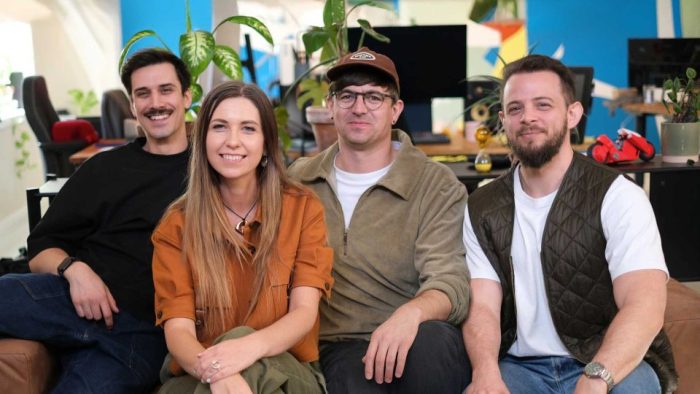
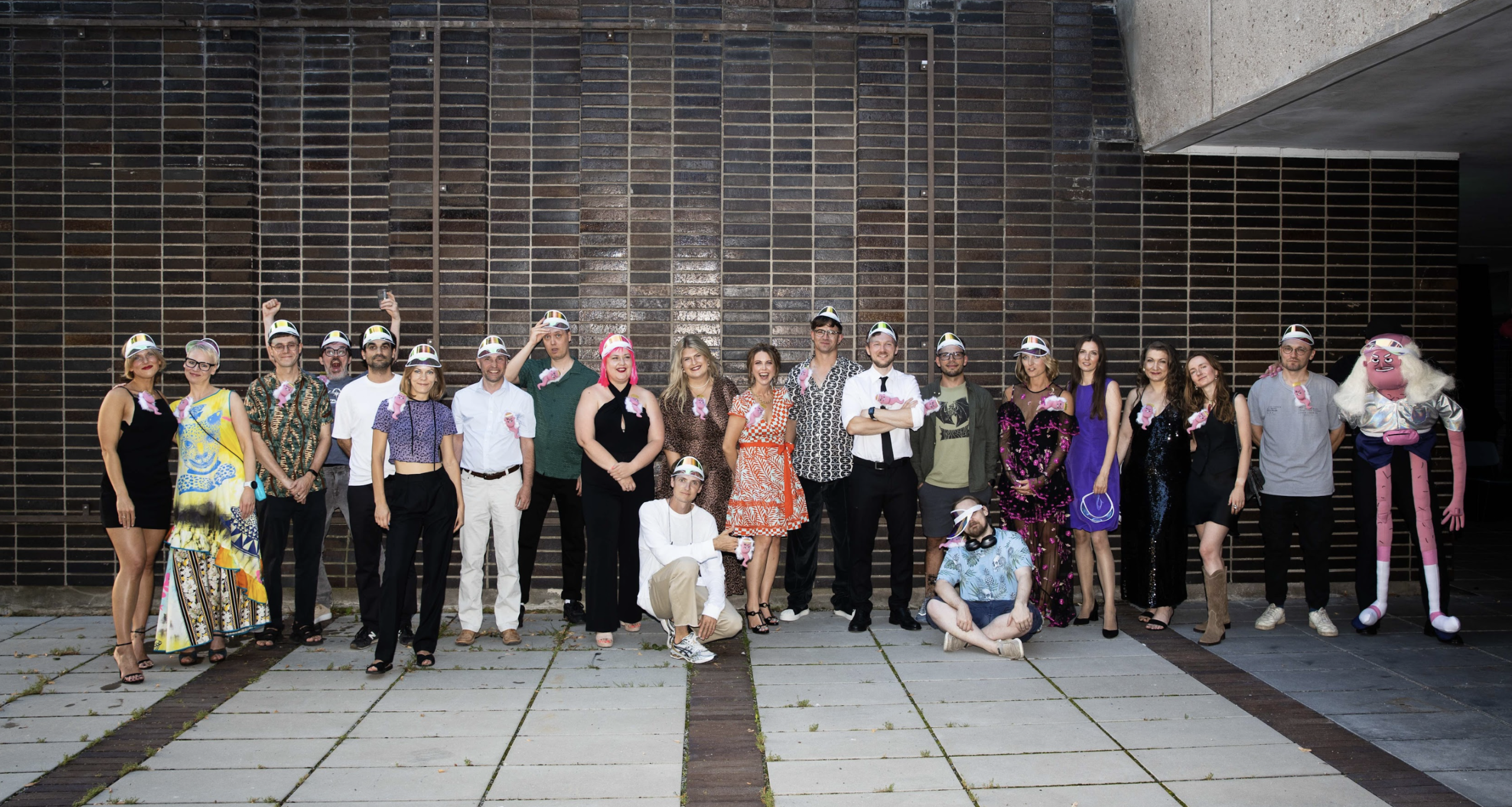
From left to right:
Maxwell Reed (Kingdom of Something), Rita Steimane (Panic), Gints Gutmanis (Panic), and Alex Grolleman (Kingdom of Something).
Wanna see more? Visit Panic here.